
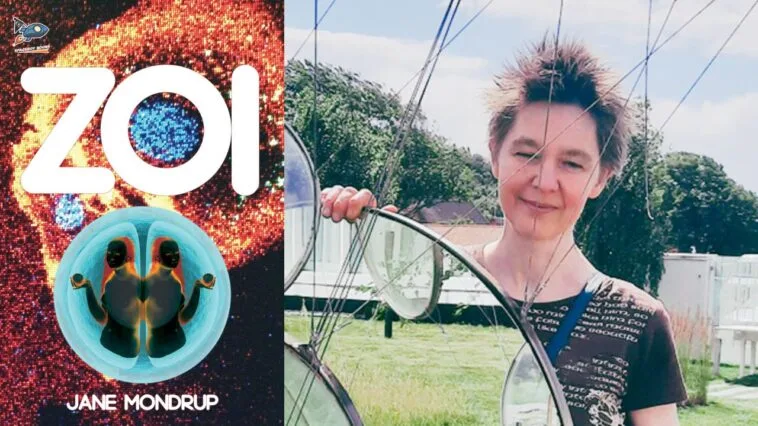
Jane Mondrup is the author of the science fiction novel Zoi, published by Spaceboy Books in June 2025. It is a first contact story in which the alien is a cell-like, space-dwelling creature. The core idea comes from biology, while the story also plays with concepts like the nature of consciousness, self vs. other, and determination vs. free will.
What inspired you to write Zoi?
About eight or nine years ago, I heard a podcast from Radiolab called Cellmates. It was about how the complex cell, the eucaryote, seemed to have originated in an endosymbiosis – a symbiosis in which a smaller organism becomes permanently integrated into a larger one. This idea settled in my mind, and one evening years later when I was on the brink of sleep, it came back in a vision of something that happens late in the book to the main character. I will prefer not to spoil it, but that vision started me off. I knew I had to get to that moment, and the story developed from there.
What surprised you the most while writing the story?
I did a rough outline before I started writing, and here the most important thing was how the four astronauts reacted to the situation. One of them, I knew, would be physically unable to adapt, and I had planned that she would die. That is the character called Linn. But then, somehow, I found myself implanting her directly into their host and letting it take over her vital functions, which was much more interesting and had a lot of implications that became central to the story.
What part of the book was the most challenging?
The ending. The dream vision represented the dramatic climax. I knew what the situation would be afterwards, and it had a lot of interesting perspectives, but in my first drafts it came out as a kind of
forward-looking infodump. Then I realized that if I jumped a bit forward in time, I would be able to let some of the perspectives play out. I’m very pleased with how it turned out.
Share one interesting or quirky fact about yourself that readers may not know.
In my twenties, I spent a year at a so-called Folk High School in Sweden (a school where you live and study subjects that interest you, outside any formal education system), learning historic and prehistoric crafts, including flint knapping, hide tanning, ceramics, textile, iron smelting and smithing, wood carving and several others. My favorite crafts were wood carving and ceramics, but I also found tanning very interesting, and I wish I could have spent more time learning flint knapping. The feeling of flint cracking when I hit it correctly was immensely satisfying. Humans have been working stone for millions of years. Something deep inside me seemed to remember that.
What’s the most memorable fan mail or fan art you’ve received?
Shortly after I published my debut novel, Zeitgeist, back in 2019, I participated in a reading event in my hometown, Aarhus, with other local authors, including a quite well-known Danish novelist called Svend Åge Madsen. I had been a fan of his weird, speculative stories since my early youth, so I gathered my courage and handed him a book, “for old acquaintance’s sake”. Not long after, I received the nicest, funniest e-mail from him, in which he told me how much he had enjoyed my story and how he saw a kinship. I’m not sure if fan mail is the correct term here, but that e-mail and our subsequent correspondence meant a lot to me.
If you could choose any fictional world to live in, which one would it be and why?
Very few fictional worlds seem like somewhere you’d want to live. I think the world of Ada Palmer’s Terra Ignota-series might be the closest I can get to a world that seems appealing, primarily because of its pluralism. I like the double system of hives and bash’houses, the former being seven geographically intermingled nations, each working from a different ideology and culture, and the latter being the immediate community of people you live with, not necessarily all from the same hive. I have only read the first two books, though, so I cannot say what I would think of the state of the world at the end of the series.
If you could have a superpower for a day, what would you choose and how would you use it?
I would want the power to change things for the better in small and subtle ways that wouldn’t go wrong, like magically bettering the world usually does in stories. The superpower should include a sense of where to make the small change, how to make sure it amplified in the right way, and where the pitfalls lay.
This is an idea I use in a few stories, including my debut novel Zeitgeist (currently only available in Danish, I’m afraid). Here, it is connected to a larger concept of time as a system working according to Chaos Theory, which means that it is changeable in smaller details, but structurally stable—to a certain point. I have also recently written a short story (unpublished so far) about a somewhat unusual Faustian pact between a human and a demon, in which the demon will make this kind of well-chosen changes to the world, and the human will pay by giving up something they love or want. Even without such a price, I would only want this superpower for a very limited time. In the long run it would be a terrible responsibility, and besides it would probably corrupt, the way power does. But for a day? I think I could handle that.
If you could time travel, which era or historical event would you visit, and what would you do there?
I would go back 35.000 years, to the time of the cave paintings in glacial Europe, specifically the ones in Chauvet Cave in southern France. These are some of the oldest examples of cave paintings surviving into the present, and some of the most sophisticated—artistically fully comparable to anything made ever since. I would mainly want to see what kind of society people had back then, and (if I could talk to them) hear how they percieved the world. Our immediate ancestors from that time would be born with brains exactly similar to ours, but there would also still be some Neanderthals around. It would be interesting to find out how different from us they really were, and how the two humankinds interacted.
If you had to choose a different career outside of writing, what would it be and why?
I’m educated as an archeologist, and though I discovered early on that I do not find the digging work interesting enough to make up for the lousy working conditions, I would still love to try working professionally with the aspects of archaeology that really appeal to me—crafts and subsistence techniques. But that kind of work is very hard to come by.
How can we find out more about you and your book?
You can find the book at the publisher’s website here: https://readspaceboy.com/portfolio/zoi/
I have a personal website too, currently mostly in Danish, but the sub-page about Zoi is in English: https://janemondrup.dk/zoi It has a link to the first three chapters of the book to read for free.
My SoMe profiles are:
instagram.com/jane.mondrup/
facebook.com/forfatterjanemondrup
janemondrup.bsky.social
Author bio
Jane Mondrup lives and writes in the small Northern European country Denmark. In her fiction, she’s exploring the boundaries around and between different speculative genres. She’s published a few books and some short stories in Danish, while Zoi, which will be published in both languages, is her debut in English.
Book info
You can also buy the book (or preorder before launch 20 June) on Amazon here: https://www.amazon.com/Zoi-Jane-Mondrup/dp/1951393422/ It’s also available via several other retailers, see https://readspaceboy.com/portfolio/zoi/