
by Miguel O. Mitchell, PhD
anOther Nemesis, the symphonic collaboration of four outstanding poets, is a poetry collection with deep, unvarnished insights into various aspects of humankind’s self-destructive nature. It is divided into four main sections: I. The Colonizers, II. Primal Sources, III. Nameless Others, and IV. Crooked Ontologies. Each section has 3–5 poems written by each poet consistently in the order Jiang, Smith, Bacon, and Gold, and each poet provides an enriching Behind the Poems explanatory preface. One poetic thread woven throughout this work is Smith’s use of haibun to describe mythological characters, the prose portion starting with their revered, tortured. or vilified past and ending with their social media-engaged, ghost-in-the-machine present, thereafter, summarized in lovely, evocative gems of haiku. A full examination of the brilliant nuances in this work of art would require a scholarly treatise, so I will confine my comments to a description of section I and a summary of the other amazing sections.
In section I. The Colonizers, language, erasure, disinformation, purity, and indifference are tools of the oppressor. In Ai Jiang’s poem “border, a definition,” her lines attempting to define “border” make it clear how nebulous the term is and yet how unyielding is its grasp on our social order.
the ripple left behind by ships
the waves churned upwards by arms floundering in the sea
clawing towards the land
Jiang’s acrostic poem with the first letter of each line blacked out, appropriately titled English, explores the use of the oppressor’s language to erase one’s cultural identity. Although the first letter of each line is blacked out, the obvious first word of each line reveals the hidden word and thus the redacted title, one of the languages used most as a weapon of cultural disintegration.
Let go of the nation that swallowed your first blood
Invite the allure of assimilation
In Smith’s haibuns in section I, she presents us with three women, feared and cursed: Lilith, Circe, and Cassandra. Lilith is the rebel who denies male rule and a god who sees women as less than. She is the enemy of the patriarchy, who tries unsuccessfully to silence every iteration of her existence. Lilith speaks through the fierce voices of womanhood who shout at rallies, podcasts, and YouTube.
Paradise in chains
a woman’s voice rising high—
Freedom from Eden.
Circe casts her spells through language and keeps the magic of woman’s primal power flowing through technology.
“Today, Circe whispers her incantations through podcasts and trending reels, her words going viral, reshaping intentions, shifting collective realities.”
Cassandra, the truthteller, warns us of our destructive ways and is ignored as the false prophetess, as fake news.
“Damned to forever warn those who don’t care to be saved.”
Eugen Bacon’s brutally honest verses, “In Effect,” “Calibration,” and “There’s a Space and Place for Mimicry,” kicked me in the head each time I re-read them. I felt like I had been in a cage match with words. Her lines were so painfully evocative that, although I was left bleeding on the ground, like a masochist in a time loop, I kept on returning to experience their vicious brilliance.
Here are lines within “In Effect” in which genital mutilation to prevent interracial offspring and to achieve racial purity is both denied and defended.
in the oddest chance that such mutilation is in effect,
it’s nowhere near ethnic cleansing but is rather a diffusion of
cultural overlap
to warrant that all exotic species are
protected entities.
And in “Calibration,” I will just reveal the first few words to shock you enough to want to read the rest.
worlding the merpeople insists on fundamental descaling and
tail amputation without anesthetics…
Maxwell I. Gold contributed three poems that reveal systemic violence towards those who will not assimilate or who are defined as “other.” In “The Walls Were Red,” my favorite lines were:
enforced by the bludgeon of dream-tyrants who sought
total submission and silent compliance for the sake of their blind
Wall-Faith fuckery
The remaining sections continue this poetic journey into the self-imposed madness of fracture-forward society, a hellscape we created but stubbornly refuse to walk away from.
In section II. Primal Sources, the poets examine who we are, our self-imposed constraints on being, and our cosmic and traumatic origin stories.
a place renamed, unnamed, renamed,
until it has forgotten what it had been
~Ai Jiang, from “A Home You Don’t Remember How to Miss” (p.24)
He codes in silence, scripts sacred algorithms, and leaves breadcrumbs of ancient insight buried in open-source files.
~Angela Yuriko Smith, “Thoth” (p. 30)
In section III. Nameless Others, these poems explore the illusion of a fixed existence, the right kind of body, and the gender binary, and propose we undam the flowing river of life’s choices instead of freezing into a block of ice.
thought he had full right
to break and repair
to cage until all that was
left were scales for
skin.
~Eugen Bacon, from “Misguided” (p. 57)
In section IV. Crooked Ontologies, the poets deal with the tricky concept of the nature of being, the lies we tell ourselves, the truths we ignore, and the hope that lingers still.
What were we going to do, time was precious, but taken for
granted while the world crumbled bit by bit
~Maxwell I. Gold, from “What Else Were We to Do” (p. 86)
In summary, anOther Nemesis will slice open your core and scoop out your sensibilities. Dive into these verses; drown in their depths. It is well worth it.
Miguel O. Mitchell, PhD is an award-winning Black speculative poet, SFF author and visual artist.
Meerkat Press $25 Giftcard Giveaway
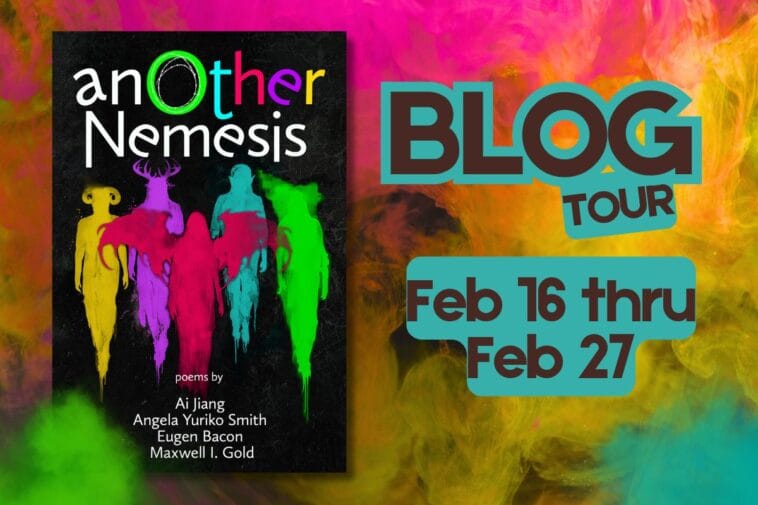
anOther Nemesis
by Ai Jiang, Angela Yuriko Smith, Eugen Bacon & Maxwell I. Gold
GENRE: Dark Speculative Poetry
BOOK PAGE: https://meerkatpress.com/books/another-nemesis/
BUY LINKS:
Meerkat Press | Bookshop.org | Amazon
SUMMARY:
This dark and thought-provoking poetry collection is co-authored by four multi-award winning authors and poets, Ai Jiang, Angela Yuriko Smith, Eugen Bacon and Maxwell I. Gold.
anOther Nemesisunravels sinister speculative poems themed The Colonizers, Primal Sources, Nameless Others and Crooked Ontologies. It reconnoitres words as weapons, reshaping to the unworldly, casting transfigurations of that which was never meant to be changed, and featuring poignant behind-the-poems by each poet.
The extraordinary assemblage interrogates the ways cultures, language, information, and the lack thereof are used as means of control; how voices will always rise against systems that rewrite identity, suppress truth, and silence dissent; the distinctions of purity and diffusion and the infinite number of fates upon which our existence is simultaneously contingent; how Ubiquitous indifference can sometimes be the cruelest villain of them all… and more!
ABOUT THE AUTHORS:
Ai Jiang is a Chinese-Canadian writer, Ignyte, Bram Stoker, and Nebula Award winner, and Hugo, Astounding, Locus, Aurora, and BFSA Award finalist from Changle, Fujian currently residing in Toronto, Ontario. She is the recipient of Odyssey Workshop’s 2022 Fresh Voices Scholarship and the author of A Palace Near the Wind, Linghun, and I AM AI. Find her at www.aijiang.ca.
Angela Yuriko Smith, former president of the HWA and publisher of Space and Time magazine, is the proud recipient of multiple awards, including two Bram Stokers. As a Publishing Coach, she helps writers search less and submit more with her weekly calendar of author opportunities at authortunities.substack.com.
Eugen Bacon is an African Australian author. She is a Solstice, British Fantasy, Ignyte, Locus and Foreword Indies Award winner. She’s also a twice World Fantasy and Shirley Jackson Award finalist, and a finalist in the Philip K. Dick Awards and the Nommo Awards for speculative fiction by Africans. Eugen is an Otherwise Fellow, and was also announced in the honor list for “doing exciting work in gender and speculative fiction.” Danged Black Thing made the Otherwise Award Honor List as a “sharp collection of Afro-Surrealist work.” Visit her at eugenbacon.com.
Maxwell I. Gold is a Jewish-American cosmic horror poet and editor, with an extensive body of work comprising over 300 poems since 2017. His writings have earned a place alongside many literary luminaries in the speculative fiction genre. His work has appeared in numerous literary journals, magazines, and anthologies. Maxwell’s work has been recognized with multiple nominations including the Eric Hoffer Award, Pushcart Prize, and Bram Stoker Awards. Find him and his work at www.thewellsoftheweird.com.